What is the role of imagination in our lives? How does it influence our experiences? These are some of the questions that many philosophers have asked throughout the ages. And the discussions are still ongoing. One thing we can say with some degree of certainty is that our ideas about imagination have changed with time (just like, for instance, our thoughts about melancholy). While I have already started exploring this topic from one contemporary perspective, here I will look into the past that has influenced the development of our thoughts.
What can we learn about imagination from two prominent thinkers in the history of Western philosophy: Thomas Aquinas and Immanuel Kant? Aquinas represents here 13th-century Latin medieval scholastic thought, and Kant is widely seen as one of the brightest lights of the Enlightenment philosophy in 18th-century Europe. Five hundred years of history, politics, social, cultural, and technological changes separate these two minds, and we are in many respects closer to Kant than to Aquinas despite living in a world significantly different than some 300 years ago (this year, 2024, marks 300 years since Kant’s birth).
Aquinas on Imagination
Thomas Aquinas developed a highly sophisticated theory of human cognition, which was embedded in his broader framework of integrating Aristotle’s ideas with Christian (Catholic) theology. Systematisation of existing knowledge, as opposed to trying to discover new knowledge, was characteristic of Latin medieval scholastic philosophy, and Aquinas is widely held to be one of its noteworthy representatives. The historical developments of thought that led to the Scientific Revolution and shifted our ideas about knowledge and nature have their roots in the late Middle Ages and run through the Renaissance and Protestant Reformation.
A Catholic, theologian, and medieval philosopher, Aquinas believed in the immaterial and immortal nature of the human soul, which informs our material bodies. He followed Aristotle’s teachings that the human soul was rational (of all embodied living creatures, only human souls were rational) and had to be united with a body to form a unified whole of a human being (what is known in metaphysics as hylomorphism1). This meant that our perception through bodily senses was indispensable to our cognition, serving as initial access to the world and providing data that could be transformed into knowledge. Where does imagination figure in this picture?
First, let me sketch Aquinas’ overall system of human cognition. It will help to situate imagination and see its role in his system. In her book, Eleonore Stump offers a helpful general summary of Aquinas’ thoughts on the structure of cognition2:
- We make some epistemic contact with the object to be known.
- We need appropriate concepts (forms, ideas) for the objects we encounter.
- We associate the appropriate concept with the object of epistemic contact, thus rendering it intelligible and known – we understand it.
The first task – making contact with an object in the world – is performed by our sensory powers. Aquinas was diligent in schematising these and came up with five external and four internal senses. What unites them into one subset of sensory powers is that each corresponds to a respective corporeal organ. Thus, the five external senses are sight, taste, smell, touch, and hearing – each is a power of a specific bodily organ (ears for hearing, eyes for seeing, etc.) With the internal senses, things get more peculiar from our modern perspective. Aquinas distinguishes the following four internal senses, which are all powers of one bodily organ, the brain: common sense, phantasia/imagination, estimative power, and memorative power. In a way, our metaphor for the brain as the control centre already has some of its roots in the 13th century. So what does phantasia / imagination do, according to Aquinas?
The common sense receives all the different and disparate data from the external senses and integrates it, but we are still not consciously aware of it at this stage. The power of phantasia gives us conscious access to the information coming from the external senses (when we are receiving sense data). It does so by creating ‘phantasms’ – Aquinas’ term for conscious appearances of what we are sensing to our intellect. In fact, Aquinas accords phantasms a crucial role in our cognition. Without them, we would not have a conscious experience of the sense data received through our external senses. It would be like a break in communication within a complex system. Sense data would keep coming in, but we would not be aware of perceiving anything. Imagination is the same power, but unlike phantasia, it uses phantasms to make something appear to our conscious mind when we are not simultaneously receiving respective sense data (like in (day)dreaming). Because of this weaker link to reality outside our minds, Aquinas thought that imagination is less reliable than phantasia and more prone to inaccuracies.
Only after phantasia / imagination has presented our minds with respective phantasms can our intellect engage with those phantasms by understanding the information encoded in them, applying concepts, and creating definitions. This is because, for Aquinas, intellect is entirely immaterial and is not linked to any organ or part of the body but to the rational human soul that informs the body. As such, intellective powers (of which Aquinas distinguishes two – agent intellect and potential intellect) can only ‘know’ or engage with data that has been sufficiently abstracted from material particularities. Therefore, phantasms are like information mediators or translators between our external (embodied) senses and (immaterial) intellect. Aquinas considered the role of phantasia and phantasms so vital to human cognition that he asserted:
“In the course of [this] present life, in which our intellect is joined to a body […], it is impossible for our intellect actually to understand anything except by turning to the phantasms.”
Aquinas quoted in Stump, 2003, p.257
Kant on Imagination
In his paper ‘Kant on the epistemic role of the imagination’, Tobias Rosefeldt claims that “probably no other figure in the history of philosophy has assigned to the imagination such a central role for our epistemic access to the world as Kant did.”3 While Kant’s role is certainly influential, to accord him such a singular honour is, no doubt, an exaggeration. However, this should not stop a curious mind from exploring.
Kant defines imagination as “the faculty of representing an object even without its presence in intuition.” (p.93)4 For example, I can imagine my cat (‘represent an object’) even without him being actually present and available to my bodily senses. Just as for Aquinas, imagination has a specific technical meaning for Kant and forms part of the metaphysical structure of human cognition. We get to know the real world through the cooperation of two cognitive faculties that cannot be reduced to each other – sensibility and understanding. Cooperation of both is required.
As ever with philosophical terms, we should be careful to avoid reading our currently assumed meanings into them. Rosefeldt explains that sensibility for Kant is a ‘passive’ faculty that enables us to have representations of objects because we, as subjects, are affected by them. An object in the world affects my senses (say, I see a cat), which results in a representation of that object in my cognition in line with how it affects me (how the cat appears to me – not how it is in itself, in its catness). Such ‘passive’ representations given to us by our faculty of sensibility are ‘sensible intuitions’. In Kant’s terms, I have a sensible intuition of this cat.
You might be wondering why sensibility is a passive faculty for Kant. To understand this, it can be helpful to see what he means by the second cognitive faculty through which we can know the world – understanding. Rosefeldt highlights that, unlike sensibility, understanding is an active or ‘spontaneous’ faculty. While sensibility takes in what is given to our senses and represents its appearance to us through sensible intuitions, understanding represents through concepts applied to these intuitions, combining such concepts to form judgments about the objects. If we include the notion of ‘reason’ into a broader concept of understanding, then this active faculty also enables us to draw inferences between the judgments it forms. Thus, understanding actively engages with the passively sensed objects.
Given the general celebration of reason during Kant’s time, which we now call the Enlightenment, it is perhaps unsurprising that, in his view, thinking is possible only in concepts: “thought is cognition by means of conceptions.” (p. 57) However, thinking alone will not give me knowledge about reality. For the understanding faculty to be able to form judgments, it requires ‘material’ to work with. If I am to think, judge, and draw inferences about cats, I need sensibility to deliver representations of cats so that I have them present in my sensible intuition. But how do these two very different faculties – sensibility and understanding – communicate? And what happens when an object is not present in intuition (my cat doesn’t always stick around for me to form judgments about him)? This is where imagination comes in to play its crucial metaphysical role. Rosefeldt writes:
“It is the indispensability of the cooperation of sensibility and understanding that explains the importance of the faculty of imagination. For the central function of the imagination is to ‘mediate’ between sensibility and understanding, a task that these two faculties on their own cannot fulfill because of the fundamental difference of their natures.”
Tobias Rosefeldt
For Kant, imagination mediates between sensibility and understanding in that it plays an essential role in our perception of objects. Sensibility can only deliver a manifold of sense data but cannot organise all that data into a unified whole we perceive as an object. Moreover, sense data is in continuous flow, not static or available to us in its entirety. Therefore, without some organising or, in Kant’s terms, synthesising activity, we could not become aware of perceiving an object. This function of synthesising is performed by imagination, which is a necessary part of perception. Further, imagination performs this work according to the ‘rules’ prescribed by understanding. Kant’s term for such a rule is ‘schema’.
A schema is like a know-how for imagination: it is a procedure according to which imagination provides a concept with its image. For example, for me to apply the concept of a cat to the perceived object, my imagination has to organise the manifold of sensible intuitions stemming from that object into a unified intuition or image of a ‘cat’ by successfully following the procedure of the schema of the concept of a cat. All concepts have their corresponding rules (schemas) by which imagination synthesises a variety of sense data into images that fit those rules. Thus, as Rosefeldt observes, the notion of schema allows Kant to show how imagination mediates between sensibility and understanding:
“The schema bridges the gap between sensibility and understanding, because on the one hand it is a rule, i.e. something general, which, like the concept itself, can be applied to several cases, but on the other hand it is a capacity to produce singular intuitions.”
Tobias Rosefeldt
One final remark on Kant. He explored the faculty and role of imagination in the first of his famous three Critiques: Critique of Pure Reason (originally published in 1781, with a second edition in 1787), a volume dedicated to metaphysics and epistemology. The other two volumes are Critique of Practical Reason (1788), which deals with ethics, and Critique of the Power of Judgment (1790), where Kant investigates aesthetic experience and judgment (the beautiful, the sublime, artistic creation) as well as the role of teleology (explanations in terms of ends or purposes) in our understanding of nature.
In his third Critique (the one on the power of judgment), Kant suggests that imagination and understanding can have a different mutual relationship when we experience pleasure in the beautiful and judge an object’s beauty. In cognition, the imagination-understanding relationship is ‘rule-governed’ where imagination is constrained by understanding (see above on ‘schema’). By contrast, our aesthetic experience relies on the ‘free play’ or ‘free harmony’ of these faculties. What does it mean?
The crucial difference is that in ‘free play’, imagination is less directed and governed by understanding than in cognition. It is lawfulness without a specific law. The relationship between the two faculties still follows the same general ‘rules’ – imagination still conforms to the general conditions of understanding to apply concepts to the objects present in sensible intuition. But now intuition is not restricted to applying any particular concept to the object. So, when I look at abstract art, for example, I still perceive it as, broadly, a unified whole (my imagination still organises the multitude of sense perceptions), but without approaching it by means of any specific concept (if I did, that would indicate an effort of understanding this work of art). For Kant, such a non-conceptual state of mind in aesthetic experience can amount to a feeling of disinterested pleasure5.
Conclusion
Perhaps surprisingly, given the five hundred years that separated them, Aquinas and Kant share some core ideas on the role of imagination in human cognition. Of course, I do not mean to deny or underplay the differences, which are plenty. However, one might have expected to see even more differences. But then again, maybe this expectation says more about our contemporary imagination of what the Enlightenment and the Middle Ages were like and how they must differ.
After all, if we look in the Stanford Encyclopedia of Philosophy for a current description of imagination, we find a lengthy entry which starts with the following definition:
“To imagine is to represent without aiming at things as they actually, presently, and subjectively are. One can use imagination to represent possibilities other than the actual, to represent times other than the present, and to represent perspectives other than one’s own.”
It turns out that our present idea of imagination – our ability to conceive of something beyond what is currently available to us – has persisted for a surprisingly long time (more than 2300 years). We saw its roots in Kant and Aquinas, but they stretch at least as far back as Aristotle. For him, it was important to distinguish imagination (or, in Greek, phantasia) from perception and mind. He understood imagination as that in virtue of which we can have something like a mental image without actual perception (as in dreams)6.
Perhaps it would be helpful for us today to remember the other aspect of imagination that both Aquinas (for him, it was phantasia) and Kant recognised. Namely, its mediating role in our perceptions of the world. Although they used different terminology, both Aquinas and Kant saw a gap between the sense data delivered through our bodies and our understanding of that data as what we perceive, our conscious experiences in the world. We don’t need to subscribe to the idea of the immateriality of the intellect or the inherently different natures of sensibility and understanding to accept the insight that all our conscious perceptions, experiences, and understandings of something are already groupings, unities, wholes structured based on some ‘as something’ instruction. I perceive this bundle of sense data as my cat. Mediation and, therefore, interpretation is an integral part of our perception, our cognition. If so, imagination as the mediator and interpreter of something into ‘as something’ (image, representation, concept, etc.) is crucial in our interaction with the world.
But where do the images or representations of our imaginations come from? Are we entirely autonomous and self-governed in terms of what we (can/not) imagine? Is it perhaps a unique talent that some just happen to be born with while others are considered ‘less imaginative’? Or is imagination a skill that can be trained and encouraged or neglected and thwarted? What might be the role of society and culture in shaping our imaginations? Is there collective imagination? Are the stories we tell or believe collective imaginings? For example, is ‘nation’ a product of collective imagination? What allows and motivates collectives to imagine differently? Is the possibility of exercising one’s imagination available to everyone equally, or are some more privileged to imagine than others?
All these questions and many more lead us away from a metaphysical approach to imagination and its long history in philosophy towards a more socially situated, experience-based approach that gained philosophical ground in the 20th and 21st centuries. They lead us to the idea of the social imaginary. While I work on this topic for my future articles, I would like to finish with Richard Kearney’s deliberately provocative and thought-provoking suggestion:
We might go so far as to say that genocides and atrocities presuppose a radical failure of narrative imagination.
Richard Kearney (“On Stories”, 2002, p.138)
keep exploring!
Sources used:
- More on the metaphysical idea of hylomorphism, developed by Aristotle, is available here: Form vs. Matter. ↩︎
- Stump, E. (2003). Aquinas. London and New York: Routledge. ↩︎
- Rosefeldt, Tobias. Kant on the epistemic role of the imagination. Synthese 198 (Suppl 13), 3171–3192 (2021). https://doi-org.ucd.idm.oclc.org/10.1007/s11229-019-02100-4 ↩︎
- Kant, Immanuel (translated by J.M.D. Meiklejohn). Critique of Pure Reason. (accessed on Google Books) ↩︎
- More on the role of imagination in Kant’s ideas on aesthetic experience and judgment is available here (SEP): Kant’s Aesthetics and Teleology. ↩︎
- A brief description of Aristotle’s thoughts on imagination is available here: Imagination (Supplement to Aristotle’s Psychology). ↩︎
P.S. Thank you for visiting me here on the humanfactor.blog! If you enjoyed this post and are interested in more philosophical content, I invite you to explore the blog, leave a comment, like, and subscribe to get notified of new posts.
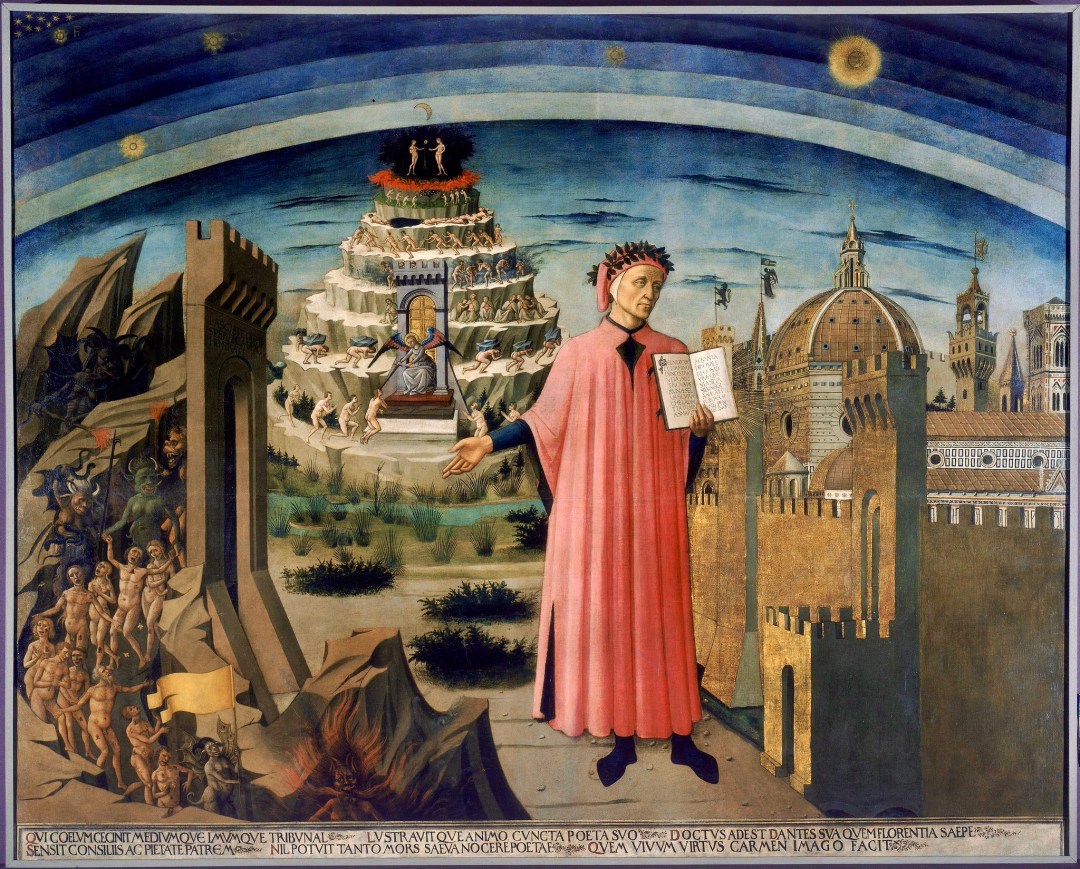
Featured Image credit: Dante Alighieri with Florence and the Realms of the Divine Comedy (Hell, Purgatory, Paradise). Dante and His Poem by Domenico di Michelino/ After Alesso Baldovinetti (1465). This is a retouched picture, which means that it has been digitally altered from its original version. Modifications: brightened image. Public Domain, https://commons.wikimedia.org/w/index.php?curid=133465311
 humanfactor
2 thoughts on “Role of Imagination: Middle Ages and Enlightenment”