What does melancholy mean? That depends on whom and when you ask. For example, the Cambridge Dictionary tell us that melancholy is “sadness that lasts for a long period of time, often without any obvious reason”. If we consult the word’s etymology – Greek melankholia, from melas, melan- ‘black’ + kholē ‘bile’ – we are brought back to its long history of medical theory, as it developed from the ancient, through medieval, to pre-modern and modern times.
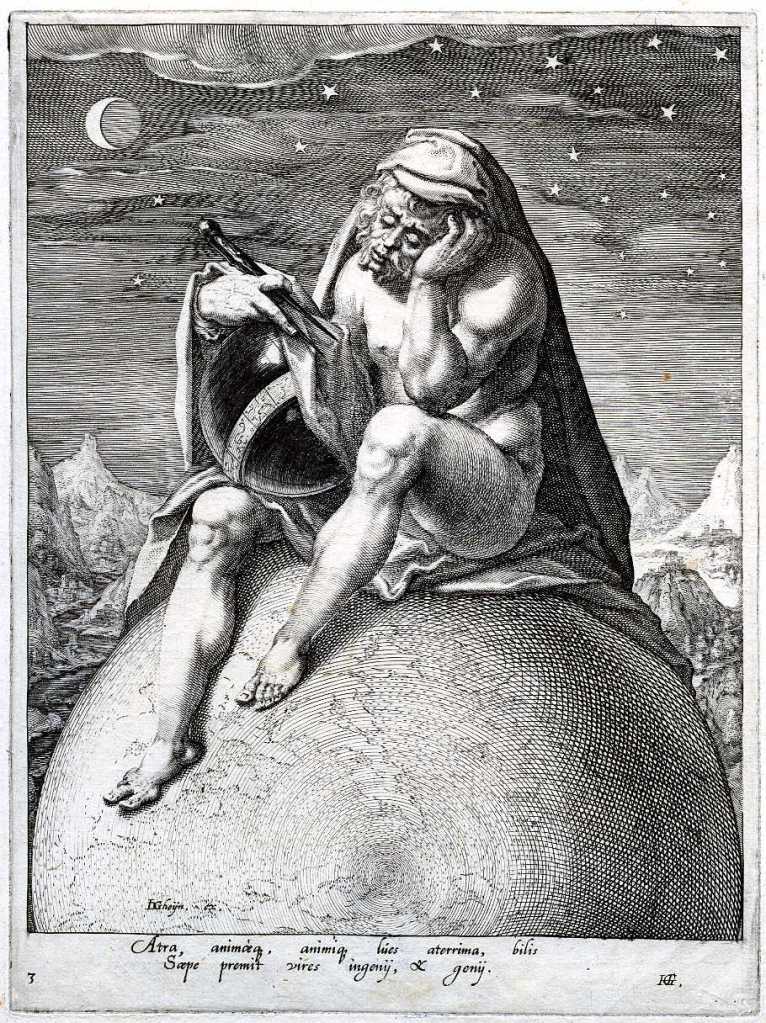
According to ancient Greek medical thought, usually attributed to Hippocrates (lived in 5th/4th century BCE), the human body consists of four vital fluids or humors: black bile, yellow bile, blood, and phlegm. These fluids regulate the physical, emotional and mental health. If there are some imbalances in the total composition, it causes ill health.
Corresponding to the four humors were the four temperaments – the dominant fluid in one’s body determined one’s personality type. These types – sanguine, choleric, melancholic, and phlegmatic – were developed by the Roman and Greek physician and philosopher Galen (lived in 2nd century CE). Too much black bile in one’s body was believed to cause one to be excessively sad and, therefore, melancholic.
Galen’s (and Hippocrates’) theory remained an orthodoxy for centuries. The Middle Ages added a religious interpretation, where, for example, sadness – melancholy – was seen as a vice caused by demonic possession. However, it was during the period of Renaissance (~15-16th centuries), when Europe was transiting to modernity, that the meaning of melancholy received a new twist.
According to Richard Kearney, “the big shift here was from the notion of melancholy as an objective physiological condition… to a specific kind of subjective mood. In his influential treatise, De Vita Triplici, Ficino marks this epistemolocal turn when he distinguishes between (1) those who make melancholy their enemy by clinging to the inauthentic banalities of the commonplace, and (2) those who transform it into a creative gift by detaching themselves from the world in order to become artists and intellectuals… The choice was now ours.”1
This curious celebration of melancholy as a mood those inclined to it can themselves choose to embrace moves us further away from the ancient and medieval interpretations and closer to the Romantic view of a melancholic artist or philosopher, a creative genius whose greatest works can only be achieved if they accept and surrender to the call of their ‘melancholic’ star. Perhaps reminiscent of the reclusive, quiet and pensive figure of a misunderstood genius, the romantic interprets a melancholic heroically abandoning the mundane world for the sake of their mystical calling.
What a long way from an excess of black bile to a creative genius detached from daily life.
keep exploring!
P.S. Thank you for visiting the humanfactor.blog! If you enjoyed this post and are interested in more philosophical content, I invite you to explore the blog, comment, like, and subscribe to get notified of new posts.
- Richard Kearney “Strangers, Gods and Monsters” (Routledge, 2003), p. 172. ↩︎
Image credit: By Gheyn, Jacques II de (1565-1629). Leiden University Libraries Digital Collections public domain: http://hdl.handle.net/1887.1/item:1631009
 humanfactor
One thought on “Melancholy: Brief History”