When things are in your mind, are they also in your body? If yes, is your body anything more than a physical container for your mind? If not, how can there be things like painful memories, hurtful words or wounds of history?
Western traditions of thought have a long history of contrasting mind and body. Part of this contrast is a hierarchy that privileges mind over body. As a result, reason and rational thought have been opposed to and valorised over sensations, feelings, and emotions, as the former gets associated with the mind and the latter with the body.
Some History
This way of thinking has deep roots that stretch back into ancient times, as vividly demonstrated in Plato’s cave allegory. Moving forward to the Middle Ages, we encounter the polymath Ibn-Sīnā, also known as Avicenna in Latin. Around 1,000 years ago, he formulated a thought experiment that we now refer to as the Flying (or Floating) Man argument. In this thought experiment, Avicenna brackets all embodied senses and experiences and asks whether something would still be left to experience. His goal is to show that we would still be self-aware, which indicates that the human mind is the essence of our ‘selves’ and is separate from the body.
In more recent times, several philosophers have taken the approach of bracketing seriously as a phenomenological method that allows us to adopt a different perspective on the world and ourselves. One of the crucial findings of their work is that such bracketing can never be complete. In other words, we can train ourselves to suspend our judgments and loosen the hold of our assumptions in order to see things differently, but our ability to do it relies on the existence of many of those things we endeavour to bracket. Avicenna’s flying man cannot wholly suspend all bodily sensations to show that our self-awareness and mind are not dependent on the body because the very activity of suspending is performed by an embodied subject. As Husserl said, “It still remains there like the bracketed in the bracket.” (Ideas I, §31)
Carnal Hermeneutics
Our brief historical excursion brings us back to the current situation where we can ask – what now? How do we proceed? An obvious way would be to counteract the dominance of the mind with the advancement of all that is associated with the body. The risk here, however, is to replace one extreme with another. We could end up toppling one idol off the pedestal only to put a different one in its place. The point is not to reverse the hierarchy of mind/body dichotomy but to deconstruct the dualistic approach itself and find a more integrated way forward.
It is precisely in an effort to avoid the persistence of the tradition that thinks of the mind, interpretation, and understanding separately from and opposed to the body, sensing, and feeling that philosopher Richard Kearney proposes a project of carnal hermeneutics. In a recent essay that contributes to a volume dedicated to exploring and thinking about the various ways our bodies are already interpreting and our interpretations are always embodied and situated, Kearney describes his idea of carnal hermeneutics as follows:
“[The task of carnal hermeneutics is] to revisit the deep and inextricable relationship between sensation and interpretation. Our wager in this volume is that such a move may help us better understand how we are constantly reading flesh, interpreting senses, and orienting bodies in passion and place even as we symbolise and dream.”
Richard Kearney “The Wager of Carnal Hermeneutics” 2015, p.17
An important argument Kearney makes is that the idea of separating the mind from the body is deeply faulty because interpretation – far from being limited to cognitively sophisticated intellectual tasks – starts from our very first embodied sensations and perceptions. That is why he calls this philosophical project to bring flesh and word back where they belong – together – carnal hermeneutics. It sees interpretation as essentially and inescapably embodied and enfleshed. Kearney proposes to undertake a return journey back to the understanding before the mind/body dichotomy – before the exile of the finite, situated, particular body from the work of abstract, universal, conceptual interpretation.
“Before words, we are flesh, flesh becoming words for the rest of our lives. Matter, no less than form, is about what matters—to us, to others and to the world in which we breathe and have our being. The old dichotomies between “empirical” and “transcendental,” “materialism” and “idealism,” are ultimately ruinous. Life is hermeneutic through and through. It goes all the way up and all the way down. From head to foot and back again.”
Richard Kearney “The Wager of Carnal Hermeneutics” 2015, p.15
To Sense Is To Evaluate
Once we return to the integrated unity of our embodied experiences, where no contrast between understanding and flesh exists, we quickly find that all our sensations are simultaneously evaluations. Being embodied means being exposed and at risk. The world can touch you in various ways, and you need to be able to interpret what those ways are like long before you develop more advanced thinking faculties. We all started our lives as babies who tested and evaluated this world by how it felt when we touched it and when we tasted it.
I would also add – when we smelled it. Some of my most surprising and oldest memories, filled with emotional associations and physical sensations, surface as if from nowhere and utterly unexpectedly when I smell a particular scent. No other sensation, let alone conscious thought, reaches these memories. And they are never merely neutral ‘facts’.
“Central to the interpretation of embodied life is evaluation… [O]ur deepest knowing is tasting and touching. We first sound the world through the tips of our tongues. Discerning between hot and cold, savory and unsavory, course and smooth.”
Richard Kearney “The Wager of Carnal Hermeneutics” 2015, p.16
Kearney’s philosophical project of carnal hermeneutics aims to combine Maurice Merleau-Ponty’s ideas of our perception and lived bodies as our medium of sense-making and communication with the world with Paul Ricoeur’s hermeneutic reflections on flesh. In other words – bringing the body and language back together. This project is an ongoing and fairly recent development in contemporary continental philosophy, so further advancements are to be expected.
keep exploring!
P.S. Thank you for visiting the humanfactor.blog! If you enjoyed this post and are interested in more philosophical content, I invite you to explore the blog, comment, like, and subscribe to get notified of new posts.
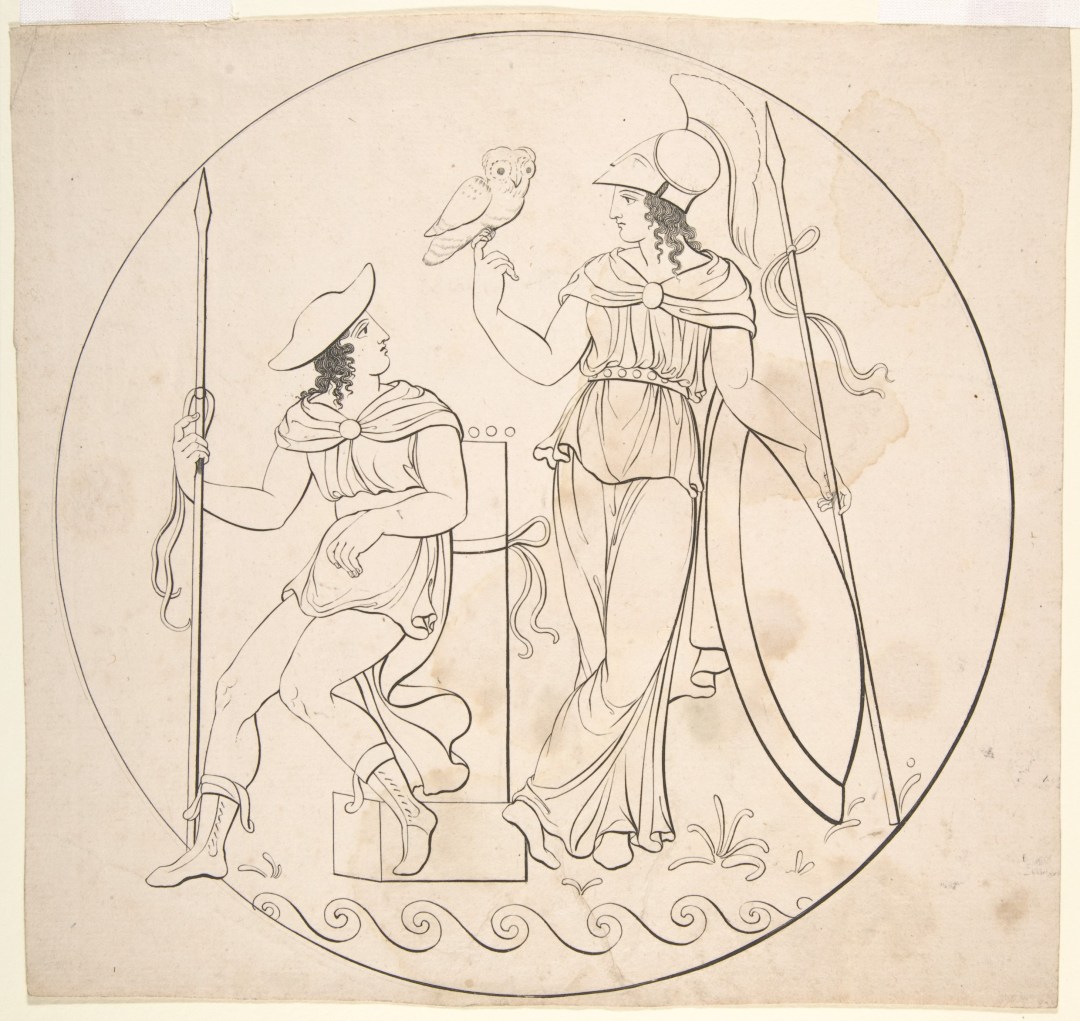
Featured image credit: Hermes and Athena (?), engraving, anonymous, German, 19th century, The Met public domain collection
 humanfactor
Very good article! I could not agree more. “We could end up toppling one idol off the pedestal only to put a different one in its place.” You are right! We have to kick the pedestal from under the idol. As you say “The point is not to reverse the hierarchy of mind/body dichotomy but to deconstruct the dualistic approach itself and find a more integrated way forward.” I find that many philosophers commit that mistake. They correctly see that the “body” is the underdog in the usual story we tell about rationality, and then they merely root for the underdog instead of questioning the dichotomy itself.
The quotes you pulled from that article are amazing. I’ll have to go check it out.
If carnal hermeneutics became mainstream, it would be a HUGE cultural shift. Truly! Because that mind/body dichotomy is so central to many human cultures. So those “recent developments” in contemporary philosophy are very exciting.
LikeLiked by 1 person
Thank you, Pierrick! I am glad you enjoyed this article. Let’s see if carnal hermeneutics becomes mainstream and what leads to. It’s definitely worth keeping an eye on.
LikeLike