Very few of us have had a chance to look at our planet. Look at it as if from a spacecraft passing by on its way to some unknown destination. We may be used to the idea of our planet as a pale blue dot and may have seen pictures of it, which is already a lot. But what would this experience do to our perspective? It is difficult to imagine.
One thing is certain – this extraordinary experience would not only move our usual, habitual perspective, but it would also transform it. This shift would unveil new ‘worlds’, new connections, new ways of looking and seeing, leading to a cascade of new, different thoughts and changing attitudes. That is the potential of extraordinary experiences – to inspire exploration and transformation.
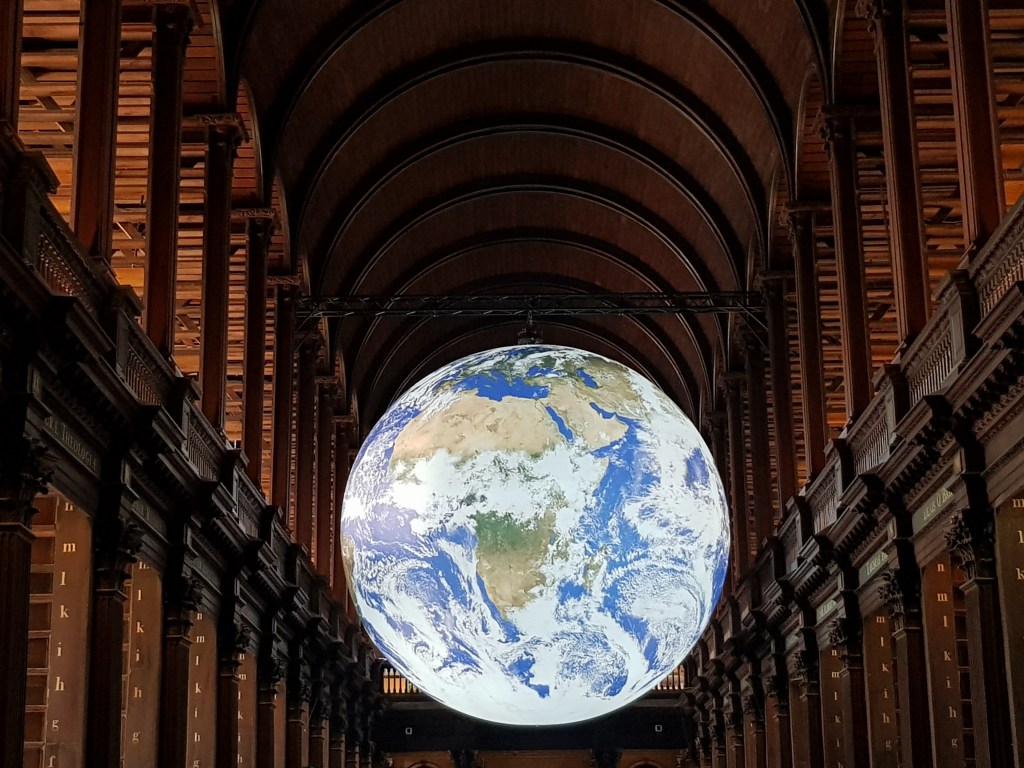
Although Gaia is an artwork – a 3D model of our planet – and not an actual view from a spacecraft, the experience of seeing it floating brightly illuminated in a dimly lit room of an 18th-century library is an extraordinary thing to perceive. Here is what exhibition curators say:
“Gaia is an artwork by artist Luke Jerram, featuring 120dpi detailed NASA imagery of the Earth’s surface. Gaia, was a mythological goddess and personification of the Earth, often referred to as ‘Mother Earth’.
The 6 metre diameter installation provides the opportunity to see our planet on this scale, floating in 3D. Common features of the experience for astronauts are a feeling of awe for the planet, a profound understanding of the interconnection of all life, and a renewed sense of responsibility for taking care of the environment.
Jerram’s intention for Gaia to highlight the beauty and fragility of the Earth chimes with that of The Old Library Redevelopment Project to safeguard the 18th century building and conserve its precious collections for future generations.”
Trinity College Dublin exhibition of the artwork “Gaia”
keep exploring!
P.S. Thank you for visiting me here on the humanfactor.blog! If you enjoyed this post and are interested in more philosophical content, I invite you to explore the blog, leave a comment, like, and subscribe to get notified of new posts.
 humanfactor